Seeing Through the Illusion of Separation
Our senses make it seem as if we're separate, just as they once made the earth seem flat. But is it true? Does our identity truly end at the boundaries of our skin?
This article grew out of an ordinary moment: a dinner conversation with my husband Rupert that drifted, as it often does, toward the nature of reality. Inevitably, he’ll say, “I need a piece of paper.” A napkin will do. What follows is an abstract sketch—an attempt to give form to the formless. The drawing that inspired this piece emerged from one of those moments. I hope you enjoy it as much as I did.
“We are one.”
We’ve all heard that spiritual saying. But what does it mean? How could it be true when we seem to be separate individuals living in a society that’s divided?
When we look around, we see a world of separation. “I am separate from you. We are separate from them.” This is the story of separation that has been told for millennia. If believed, this story leads to psychological suffering. If enacted, it leads to disharmony. If enforced, it leads to war and oppression.
But is the story of separation even true? Does our identity truly end at the boundaries of our skin?
How Separation Appears
To explore this, let’s imagine that the page on which these words are written represents reality, the essence of existence. These two circles represent two seemingly separate individuals, me and you:

The circles represent two seemingly separate individuals, and the white background represents their shared reality, the essence of everything.
The circles represent two seemingly separate individuals, and the white background represents their shared reality, the essence of everything.
Imagine taking the perspective of one of the circles, looking through its curved boundary at the other one. From this vantage point, the other circle looks like a separate entity. The same applies if you take the point of view of the other circle. From the perspective of each circle, the other one appears separate.
The same is true for us. You and I view each other through the lens of sense perception: seeing, hearing, touching, tasting and smelling. From this limited point of view, we appear to each other as separate individuals.
The sense of separation is further reinforced by our private thoughts and feelings. I don’t know what you’re thinking right now, and you don’t know what I’m thinking. This seems to confirm our apparent separation. Let’s add thoughts and feelings to our picture:
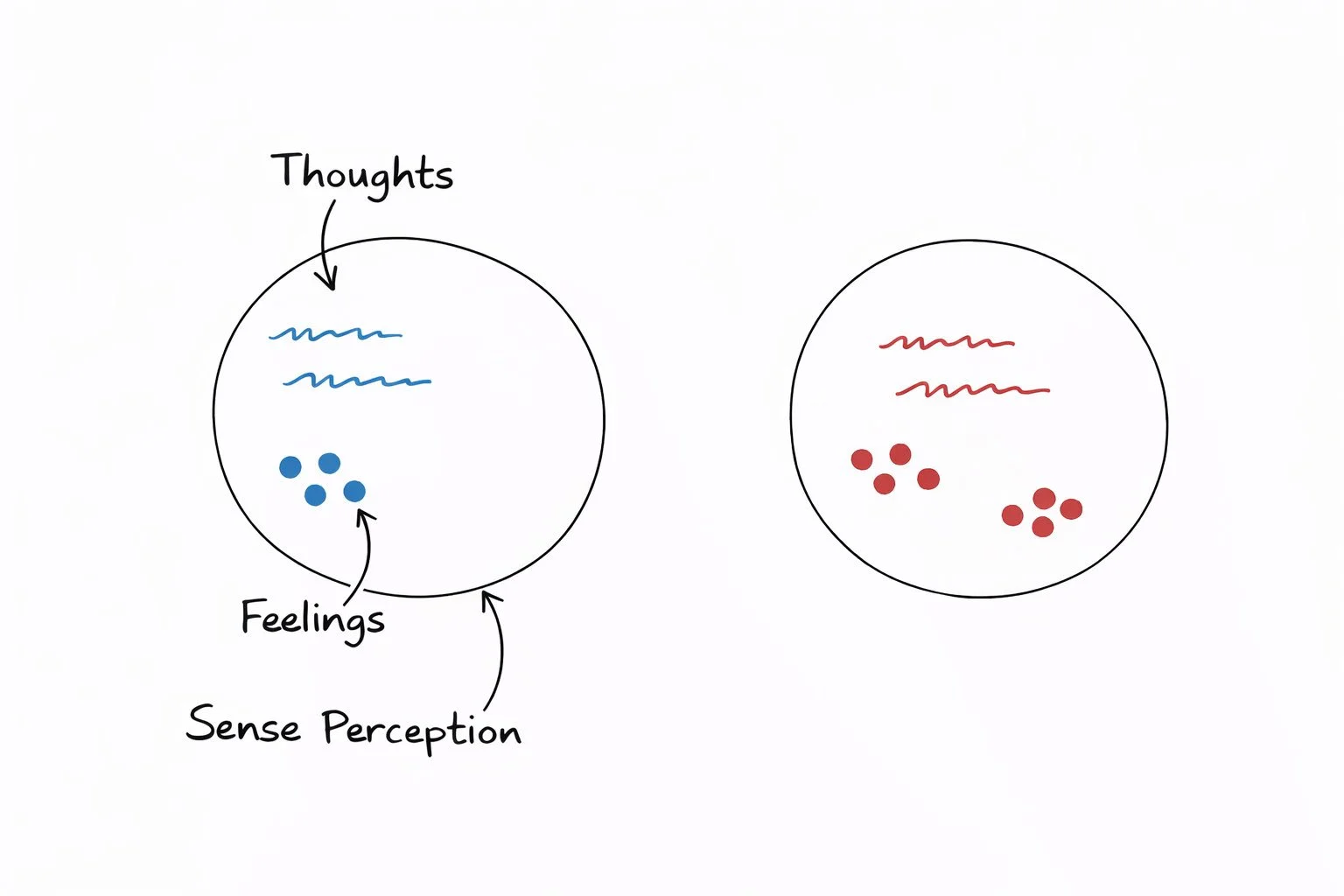
Sense perception seems to divide us. Our private thoughts and feelings seems to confirm our separation. But what about the insides of the circles?
Sense perception seems to divide us. Our private thoughts and feelings seems to confirm our separation. But what about the insides of the circles?
If the circles focused solely on what is drawn on the page, they would feel like two completely separate entities. Likewise, if we focus solely on our thoughts, feelings and sense perceptions, we seem to be separate.
But what about the essence of the circles: the white page? The interior of each of the circles is exactly the same. It’s the same page, the same background.
What if the same were true for us? What if we share the same background or reality? What if the essence of each of our minds, in spite of our private thoughts and feelings, were one? What if the consciousness with which you are reading these words right now is exactly the same consciousness with which I have written them? [1]
Let’s explore this in your current experience. Right now, you are aware of certain sense perceptions, such as the sights and sounds that surround you. You might also be aware of certain thoughts or feelings, such as the memory of yesterday or a quiet sadness. The same is true of my experience: I am aware of these words as I write, the crackle of the wood-burning stove, a thought about dinner, and so forth.
We assume we’re separate because we experience different thoughts, feelings and sense perceptions. But this is akin to overlooking the white page, focusing on the squiggles and dots, and assuming the circles are truly separate. In our case, we feel as if we are localized in a body, completely separate from others. This, however, is a compelling sensory illusion.
The Illusion of Separation
Modern research on sense perception has shown that our senses do not give an accurate rendition of reality. Our senses are extremely limited, and they do not reveal reality; they conceal it. The neuroscientist Anil Seth went so far as to describe perception as a “controlled hallucination.” He said, “Our experiences of the world around us—and of ourselves within it—are forms of controlled hallucination.” [2] “We’re hallucinating all the time; when we agree about our hallucinations, we call it ‘reality.’” [3] In other words, nearly everything we experience—the sights and sounds that surround us, the memory of yesterday, the feeling of sadness—is our mind’s representation of reality, not reality itself.
We tend to think of our senses as clear windows that offer an unobstructed view of “the world out there.” We assume the sky is blue because the color blue lives “out there” in the world. But the color blue—and indeed all colors—appear “in here,” that is, in our minds. The experience of color comes from the configuration of the human mind: how our minds filter, process and simplify information into a specific visual image, which we refer to as “blue.” The world doesn’t come pre-colored. There is no color in the world. In fact, there is no “world out there,” at least in the way we perceive it. What appears as “a world out there” is, in fact, a “controlled hallucination.”
The same is true of your body. The experience of bodily sensation—the tingling sensations in your hands, the feeling of your feet on the floor, the sense of your legs as they move through space—these, too, are part of the simulation of separation. [4] The feeling of being a limited, separate self—a separate “me” localized in the body—is a construction of our own minds. This is similar to believing that the page is limited to the circle.
Our everyday experience is much closer to a psychedelic trip than perhaps any of us would like to admit. This is why the contemplative traditions have said, “The world is an illusion.” The world as we perceive it is an illusion. The world is not what it seems. We cannot trust our senses to give us an accurate picture of reality.
Inevitably, we relate to one another through the senses and thus appear as many separate beings. This is the illusion of separation. We then wrap that illusion in language: describing our experience from the limited vantage point of “me, the separate self” relating to “you, the separate other.” These are the two main characters of the story of separation, which has become the great drama—and tragedy—of human history. We all know how painful it is to be cast as an “other” in someone else’s story of separation, and we can all see the horrors that unfold when humanity embraces this strange concept of “other.” Every form of oppression—without exception—emerges from the mind of separation.
Our Shared Reality is Within
So what do we do? The situation is far from hopeless, and we can exit the matrix of separation in this very moment. But we need to know where to turn. The exit is not “out there” in the hallucination of perception. Just as a tinted lens colors everything we see, if we peer through perception we will always see the illusion of separation. This is precisely why we cannot search outside of ourselves. We must go within. [5]
The two circles appear as separate entities, but their insides are the same white page. If they wanted to find their shared reality, they would only need to notice their own innermost experience. That inner experience, which seems separate and private, is in fact their shared reality. Likewise, we seem separate but share the same background. To find it, we must go within to our innermost experience.
The Recognition of Awareness
When we first go within, our attention might become absorbed in thoughts or feelings, just as it becomes lost in the drama of a film. But our thoughts and feelings are not the white page. They are not the ground of experience. We need to take another step back and ask ourselves: “What is the background of my experience? What is it that knows my thoughts and feelings?”
It’s awareness, the simple experience of being aware. It’s not a special, spiritual awareness that only belongs to the so-called gurus, but your awareness—the one that is aware of this very moment.
When you go within, you notice the simple experience of being aware. Thus you can say, “I am aware.” When I go within, I also notice the experience of being aware. Thus I say, “I am aware.” What if we are referring to the same “I?”
What if our awareness, which seems separate and private, is like the white page inside both of the circles? What if you and I are experiencing the same awareness when we go within? Our thoughts, feelings and perceptions may be different, but that doesn’t mean awareness is.
One Awareness, Many Forms
If any of the eight billion people on the planet checked their inner experience, they too would conclude, “I am aware.” They would discover the same awareness. If I drew eight billion circles on the page, they would all share the same interior. I could even draw the circles in clusters and give them names, like “men” and “women” or “Muslims” and “Jews.” I could draw squares or rectangles or octagons of all different shapes, sizes and colors. They would all share the same interior. Their essence would be the same.
Likewise, humanity is a gorgeous rainbow-display of people of different shapes, sizes and colors. We seem separate when we view one another through the lens of perception, but that is a sensory illusion. In reality, we share the same essence. This is why we refer to our self by the same name, “I.” It reflects our deep intuition that, ultimately, we are one.
We are one universal consciousness, one witness with many eyes. Just as light refracts itself through a prism and shines as many colors, pure consciousness refracts itself through perception and shines as many people. You are the eyes and ears of God, and so is everyone you will meet today.
There is only the self; there is no other.
This is the sacred knowledge of unity. If humanity forgets, we create a nightmare of separation. If we remember—and if we bring society into alignment with this knowledge—then we can create the future we know is possible: one that is fundamentally peaceful and just. This is the ultimate yoga.
I use consciousness, awareness and presence interchangeably.
Anil Seth. (2021). Being you: A new science of consciousness. Faber & Faber.
Seth, A. (2017, April). Your brain hallucinates your conscious reality [Video]. TED Conferences.
Some researchers, including Seth, define perception broadly to include the various bodily senses involved in the felt-experience of being located in a body that is moving through space.
This is also why people often close their eyes when they meditate. They intuitively understand the fact that sense perception is illusory and, therefore, tells us nothing about reality.